Photo: Voz Minera Radio
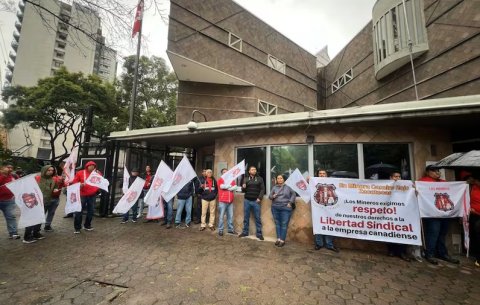
On March 26, the three-member expert panel in the Rapid Response Mechanism (RRM) case initiated by the US government against Canadian mining company Orla Mining published its determination confirming worker allegations that management at its Camino Rojo mine in Mexico’s Zacatecas state had interfered with their associational rights.
The panel of experts also confirmed that the employer had failed to respond to urgent requests for help from workers who had received death threats because of their support for Los Mineros union, rather than a protection union favoured by the employer. According to Los Mineros, a well-known member of a drug cartel who was responsible for the death threats was employed by the company on a sub-contract basis.
However, rather than accepting the panel’s findings and demanding stronger corrective action by the company, Mexico’s Secretaries of Labour and the Economy challenged those findings, arguing that the threats of violence were a criminal matter beyond the scope of the RRM, and that the mine was not a covered facility under the trade agreement.
According to Alfonso Bouzas, a leading Mexican labour rights expert, the Secretary of Labour's interpretation of the facts is concerning. “His statements show a lack of understanding of the rapid response mechanism. The Secretary resorts to rhetorical argumentation, as if it were necessary for the employer to have blood on his hands to be held responsible.”
On May 4, Orla Mining released a public statement confirming the remediation measures it has agreed to take to comply with the recommendations of the expert panel. These include acknowledging “evidence of potential criminal activity” at the mine; replacing the general manager; implementing a new labour rights policy and issuing an employer neutrality letter; training management staff and employees on labour rights, compliance obligations and reporting mechanisms; and, most importantly, committing to safeguarding minority union rights and providing Los Mineros representatives access to the mine.
The remediation plan does not, however, include a strong commitment to protect the safety of Los Mineros supporters who have received death threats and are still in hiding, which would enable them to return to their homes and workplace. This would also require strong commitments to their protection from the Mexican authorities.
Another important issue reinforced by the Camino Rojo case is the excessive length of time it can take to resolve a “Rapid Response” complaint when a government chooses to delay the process.
The complaint was filed by Los Mineros on June 24, 2024, and in late August the US formally requested that Mexico review the union’s allegations. At the conclusion of the 45-day review period, Mexico responded by challenging the validity of some of those allegations. As a result, in December 2024, the US requested the creation of the expert panel. The panel released its written determination in late March 2026, almost two years after the complaint had been filed.
Meanwhile, the United Steelworkers filed a parallel complaint about the same case with the Canadian government in November 2024, but the Canadian government did not formally request that Mexico investigate that complaint until April 2026.
The RRM is a unique feature of the trinational trade agreement between Mexico, Canada and the US that allows interested parties to file complaints when employers in facilities covered by the agreement violate workers’ rights to freedom of association and to bargain collectively.
Since the trinational trade agreement came into force in July 2020, there have been more than 45 RRM complaints accepted by the US government and two by the Canadian government. While most cases have been resolved relatively quickly with remediation plans accepted by the affected employers, the Camino Rojo case demonstrates the urgent need for improvements in the process.
According to Paul Bocking, Project Officer with the Steelworkers Humanity Fund, these two issues – the unwillingness of the Mexican government to accept the findings of a panel of experts and the unnecessary delays in the process -- must be on the agenda of the upcoming review of the trade agreement. On May 27, the Canadian National Office of the United Steelworkers released a public statement on the case, urging the Attorney General of Canada to consider criminal charges against Orla Mining.
For more information:
- Canadian firm ignored worker complaints over drug cartel-management links at Mexican gold mine, sources say (CBC)
- Labour violations, criminal allegations at Canadian-owned mine in Mexico: Steelworkers demand action from Canadian government (USW)
- List of RRM cases accepted by the US government
- Brief summaries of the first dozen RRM cases (MSN)