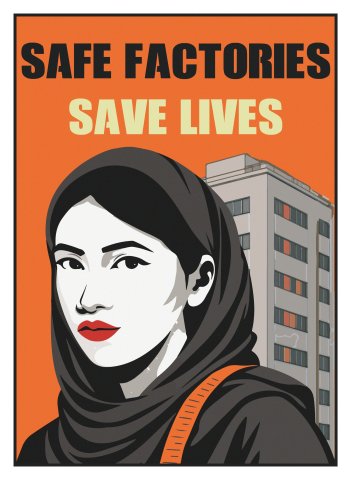
Art by Asif Mahmud.
Today, MSN joins with our trade union and labour rights allies in Bangladesh and around the world in honouring the more than 1,138 workers who were killed and over 2,000 seriously injured in the Rana Plaza disaster.
Thirteen years later, most Bangladeshi garment factories are safer because of the precedent-setting and legally-binding International Accord for Health and Safety in the Textile and Garment Industry and its predecessor, the Bangladesh Accord on Fire and Building Safety.
While the accomplishments on health and safety are significant, much more needs to be done to protect garment workers in Bangladesh.
Currently, the Accord does not protect workers in certain stages of the production process, such as fabric production, washing and dyeing, and spinning mills. Additionally, there are notable safety hazards, such as heat stress, that are not currently included in factory inspections under the Accord. Heat stress is already placing an incredible strain on workers and will only be made worse by climate change.
As one of the three active witness signatories to the Accord, together with the Clean Clothes Campaign and the Worker Rights Consortium, MSN is calling for the expansion of the Accord safety inspection program to cover workers involved in more steps of the production process and to address heat stress and other climate-related hazards. With the Accord’s Bangladesh agreement coming up for renewal at the end of 2026, there is an opportunity to expand its scope as part of that process.
We are also calling on Accord signatory brands, to ensure that there is no employer interference in any part of the Accord’s operations – from factory inspections to health and safety training and the complaints mechanism.
Rana Plaza was a preventable, man-made disaster. The multi-story building housing five garment factories collapsed because structural cracks in the building were ignored by the factory owners and overlooked by the social auditors who did health and safety inspections for brands that were sourcing from those factories.
Brands that have yet to sign the Accord should do so and all brand signatories should continue to politically and financially support its effective implementation and expansion in order to adequately ensure the health and safety of garment workers in their supply chain.
On the thirteenth anniversary of the Rana Plaza disaster, Bangladeshi garment unions are calling not only for health and safety protections and increased compensation for the survivors and victims’ families, but also for a living wage, respect for workers’ associational rights, and a fair and effective labour justice system.
For more information: