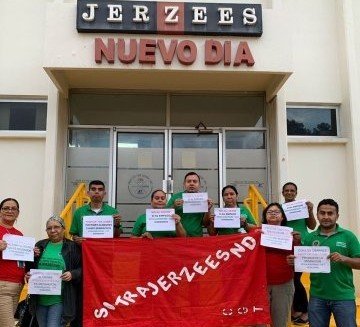
Union members call on Fruit of the Loom to reopen the
Jerzees Nuevo Día factory in Honduras.
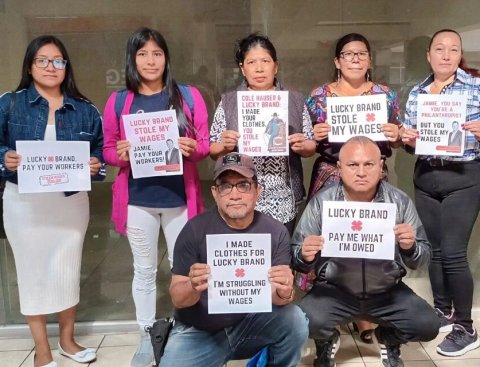
Workers call on Lucky Brand to address severance theft
after the closure of the Industrial Hana factory in Guatemala.
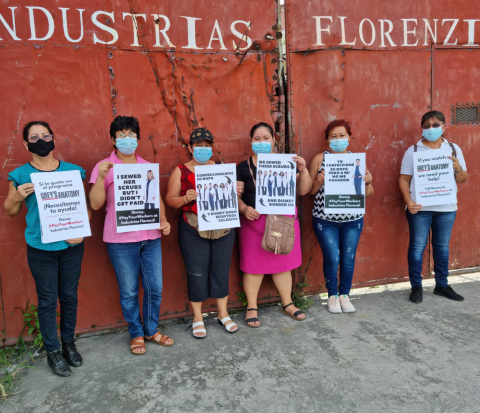
Workers call on Disney and their Grey's Anatomy brand to ensure full payment
of severance owed after the closure of Industrias Florenzi in El Salvador.
The past five years have seen major disruptions in the global garment industry, including the global pandemic in 2020, the growth of fast fashion and e-commerce, widespread closures and mass layoffs, the expansion of private equity-controlled brand management companies, and more recently, sweeping changes to global trade starting in 2025.*
The wave of factory closures and mass layoffs in garment manufacturing facilities in Central America has had a devastating impact on garment workers, their families and their unions.
In Honduras and El Salvador, many of these closures and layoffs have been in large, wholly-owned facilities of major North American manufacturers of apparel basics, such as Hanesbrands, Delta Apparel, Fruit of the Loom and Gildan Activewear. By the end of 2025, Delta Apparel had filed for bankruptcy, Fruit of the Loom had ceased to be a major presence in Central America, and Hanesbrands had been acquired by Gildan, which is now the largest basics apparel manufacturer and employer in the region.
In Honduras, prior to 2023 those four companies directly employed the majority of garment workers in the country, and over the previous decade unions had been successful in negotiating collective bargaining agreements (CBAs) with improved wages and benefits in many of the larger factories. A 2022 study by Mark Anner estimated that approximately 44% of the country’s garment workers were covered by and benefiting from a CBA at that time.
As a result of the closures that have taken place over the last two years, Honduran garment unions are seeing their hard-won gains being lost. Between April and December 2025, Fruit of the Loom (FOTL) closed its last three unionized garment and textile factories in the country, laying off approximately 4,000 workers and reneging on a 2009 groundbreaking agreement with the Central General de Trabajadores (CGT) that had guaranteed freedom of association at all FOTL facilities in Honduras and opened the door to unionization at other factories in the country. According to the WRC, FOTL once employed approximately 7,000 workers in unionized facilities in Honduras. The company has since eliminated over 90% of those jobs.
The closure of Hanesbrands’ wholly-owned facilities in Honduras has been just as dramatic. In 2022, Hanesbrands owned six facilities employing over 9,000 people. By the end of 2025, the company had closed its last wholly-owned facilities in the country. The latest closure alone left more than 2,200 workers from the Confecciones del Valle facilities unemployed. The largest Hanesbrands factories in Honduras were all unionized, with at least two of these producing the Hanesbrands’ Champion brand, which was sold to brand management company Authentic Brands Group (ABG) in September 2024.
Gildan Activewear closed its San Miguel factory in June 2023, leaving 2,700 workers unemployed at the time.
In El Salvador, Hanesbrands and FOTL went from owning 12 factories in 2022, three of them with a union presence, to currently owning and operating only seven.
Delta Apparel, which produced for a number of major brands in their facilities in Honduras, El Salvador and Mexico, filed for bankruptcy in June 2024, leaving thousands of workers unemployed and owed millions of dollars in severance and other legal terminal benefits.
Together these layoffs, particularly those at well-known unionized facilities, have widespread impacts for workers needing to address factory level workers’ rights violations in the region. The loss of union representation and coverage by a CBA leave workers with fewer resources to address rights violations and/or create working conditions in which they are less likely to occur.
In addition, the fact that so many factories with the presence of one or more unions have closed will have a chilling effect, discouraging workers from even attempting to exercise their rights to freedom of association and collective bargaining in the region.
Illegal closures and severance theft
In addition to the factories wholly owned by international manufacturing companies, over this same period, a significant number of supplier factories in Central America have closed, leaving workers with millions of dollars in outstanding benefits, most notably severance, back wages, and social security payments.
Despite important precedents, too few brands proactively assume the responsibility to ensure workers are paid legally owed severance and other terminal benefits when supplier factories close, and the Fair Labor Association (FLA), which includes many of these brands, does not require participating companies to compensate workers when their suppliers fail to live up to their legal obligations to provide terminal benefits.
In response to severance theft, local unions have filed legal injunctions and organized national campaigns. When those efforts proved unsuccessful, they expanded their strategies to seek the support of international allies, often filing complaints with the WRC, and involving the Solidarity Center local offices, MSN and other labour rights organizations in coordinated campaigns to pressure brands to live up to their responsibility to ensure the workers making their products receive full severance and other benefits owing.
In Central America, significant victories include securing contributions of over US$4 million for the former workers of three factories in El Salvador (APS El Salvador, Style Avenue, and Industrias Florenzi); and US$1.5 million for the former workers of Industrial Hana in Guatemala.
These campaign victories are important to note, in part to recognize the incredible amount of time and energy invested by workers, unions, and international labour rights organizations for workers to receive what is already legally owed to them when brands do not proactively assume responsibility after factories close. It is time that brands and multi-stakeholder organizations, such as the FLA, accept their responsibilities to workers when factories that produce their or their affiliates’ products close, leaving workers owed thousands, often millions of dollars of legally required back wages, severance and other terminal benefits.
*This story is excerpted from MSN's publication Companies and their Brands: Holding companies accountable in an opaque industry. Please see full publication for more information and reference notes.